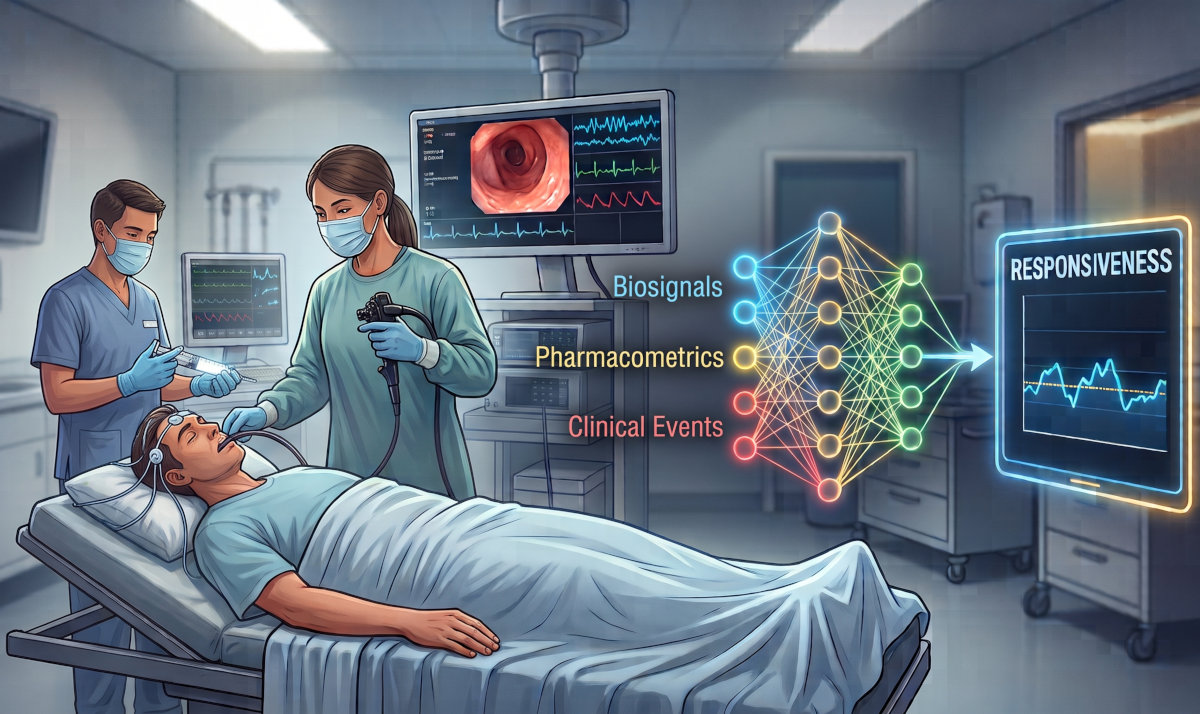
For this ICASSP 2027 Signal Processing Grand Challenge, we invite teams from signal processing, machine learning, clinical monitoring, anesthesia, neuroscience, and consciousness research. The challenge asks participants to forecast a clinically observed response to propofol from multimodal signal information available at the time of administration. Training data are derived from the publicly available DOSE-I dataset. Final evaluation will use an independent and unreleased clinical cohort. The challenge is open October 1 to December 1, 2026.
Propofol, an intravenous anaesthetic agent used to induce and maintain sedation, produces responses that vary both between patients and within the same patient over time. In clinical practice, sedation is therefore adjusted using the patient’s current response together with prior doses and physiological information. This raises the question: Can we predict how a patient’s responsiveness will change before a propofol dose takes effect? Existing brain-function monitors primarily estimate the current sedation state rather than predicting how it will change following a dose.
From a signal-processing and machine-learning perspective, this is a challenging forecasting problem: heterogeneous and noisy observations must be mapped to an evolving, only indirectly observed physiological state and then to a clinically meaningful future response. The mapping may vary across patients and over time, making generalization non-trivial. While current-state estimation is possible, it remains unclear whether information available before a propofol dose takes effect contains sufficient signal to anticipate the subsequent response. This motivates investigating whether pre-dose observations can predict changes in responsiveness.
The task is clinically relevant but remains modest in scope. The target is observed behavioral responsiveness. It is not a direct measure of subjective experience. Still, reliable forecasting of a behaviorally defined state transition under a pharmacological perturbation can also support serious consciousness research. It tests state-dependent susceptibility rather than only separating already existing states
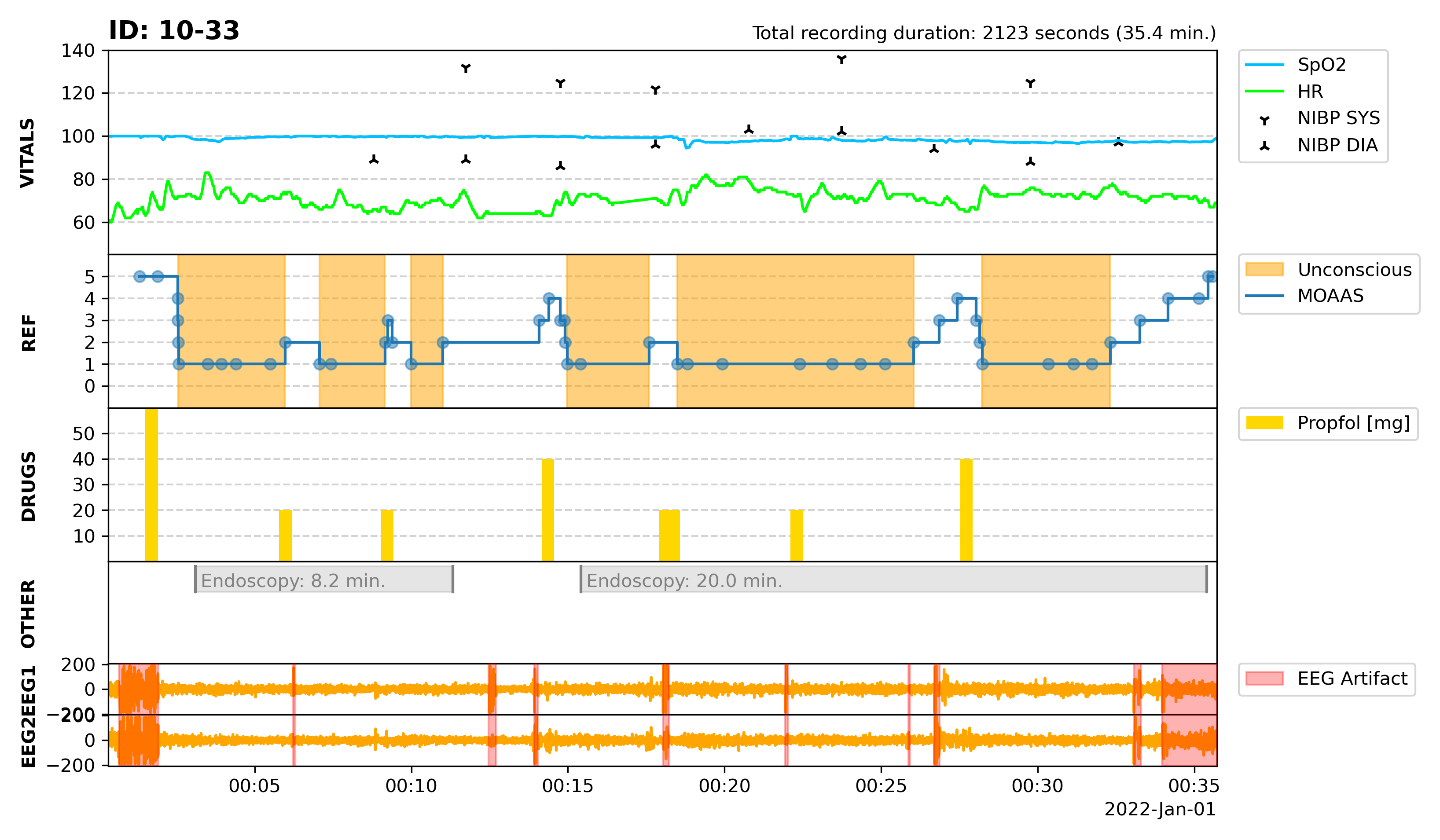
This challenge treats propofol administration as a known perturbation of a changing physiological system. Propofol was administered in boluses. During real-time annotation, each bolus was documented as repeated 10mg event markers and grouped again in post-processing as long as event markers were less than 10 s apart. Each bolus is timestamped to the first in a group of 10mg event markers.
The main question is simple: Does the pre-dose brain and body state contain information about the future response beyond current responsiveness, dose history, patient characteristics, and standard pharmacokinetic estimates?
For each positive-dose or matched zero-dose reference episode, predict the future MOAA/S level approximately 60 s after the index time.
Each episode contains a 30 s input window [t-30 s, t). For positive-dose episodes, t is the grouped propofol administration time in the challange dataset. The target is the MOAA/S assessment closest to t+60 s; an episode is included if an assessment is available within ±15 s of this time. Episodes have been excluded if another propofol administration occurs between t and the target assessment.
The secondary target is the direction-of-change of the future MOAA/S level. Direction of change is derived as
where −1 means more responsive, 0 unchanged, and +1 less responsive.
Training examples are derived from the publicly available DOSE-I dataset, which contains 171 routine endoscopy recordings, 78.5 h of multimodal data, and repeated clinical responsiveness assessments.
The challenge training set contains 662 positive-dose episodes and 662 matched zero-dose reference episodes from 169 DOSE-I recordings. Episodes containing signal artifacts are retained. For local validation, we recommend splitting the data by recording rather than by episode to avoid leakage.
Final evaluation will use held-out recordings that are not publicly available.
The orginal DOSE-I dataset is available for download via Zenodo. Accompanying this dataset, we have published a comprehensive technical documentation on arXiv.
A challenge-specific table and fixed signal windows are provided. This avoids requiring participants to reconstruct the full clinical timeline. Each example will contain a recording-group identifier for subject-wise validation. Whole-recording summary fields and all information produced after the index time will be removed to prevent leakage.
The DOSE-I dataset includes five primary biosignals:
Additional data include derived vital parameters such as heart rate, respiratory rate, and blood oxygen saturation, clinical event annotations, static patient information, and processed EEG features. Teams may use any subset of the provided modalities. Missing data are marked explicitly.
The challenge includes matched 0 mg reference episodes. These are real clinical time points without a new propofol administration before the target assessment. They use the same input and target format as positive-dose episodes.
Matching uses only information available at the index time, such as current MOAA/S, elapsed procedure time, prior propofol exposure, and time since the previous dose. Outcomes are not used for matching. The primary dataset uses at most a 1:1 zero-dose to positive-dose ratio. Performance is reported separately for both strata.
In addition to raw EEG data, a set of 40 processed EEG (short: pEEG) parameters are provided. Derived from raw EEG signals, these numerical features simplify brain activity into values clinicians can use—especially to monitor depth of anesthesia or sedation.
These additional features are part of the DOSE-I dataset and include 25 pEEG features derived from EEG bands as well as 16 well-established pEEG features from the scientific literature, such as Spectral Edge Freqency 95%, Weighted Spectral Median Frequency Permutation Entropy, SynchFastSlow, Bicoherence of SFS, and PowerFastSlow.
Complementing the publicly available DOSE-I dataset, registered participants are provided four Eleveld-model states:
The challenge files distinguish states immediately before the index episode from projected states at the target horizon after including the known index dose.
Eleveld-model states have been calculated from the dosing history and required patient covariates at a 1 Hz frequency using the PyTCI package.
Challenge evaluation will use an independent and non-public dataset of 150 recordings collected under a closely matched protocol. 50 of these recordings will be used for intra-challenge feedback, 100 of these recordings for final evaluation.
The challenge feature data for the evaluation episodes are released with pseudonymous challenge identifiers. Target MOAA/S labels remain hidden.
For each evaluation episode, teams submit one predicted future MOAA/S value and one predicted direction of change
The primary score is recording-balanced mean absolute error (MAE) for future MOAA/S, averaged equally across positive-dose and zero-dose episodes:
where each MAE is first averaged within recording and then across recordings. Lower is better. This prevents patients with many episodes or a larger zero-dose subset from dominating the ranking.
Teams will submit one future MOAA/S prediction per episode and may additionally submit a probability distribution over levels.
Secondary metrics are:
| Challenge opens | October 1, 2026 |
| Final submission deadline | December 1, 2026 |
| Results and invitations | December 8, 2026 |
| Invited 2-page papers due | January 7, 2027 |
| ICASSP 2027 | May 16–21, 2027, Toronto, Canada |
Register your team via email to DOSE-I-Challenge@medizin.uni-halle.de and include:
For further questions, please contact DOSE-I-Challenge@medizin.uni-halle.de.
This work was supported by Deutsche Forschungsgemeinschaft (DFG, German Research Foundation) under Project number 547230187.