Towards Predicting Sedation Depth in Endoscopy with Large Clinically Annotated EEG Data of Continuous Propofol Sedation

1University Hospital Halle, Halle (Saale), Germany, 2Martin Luther University Halle-Wittenberg, Medical Faculty, Digital Research Methods in Medicine Group, Halle (Saale), Germany, 3Martin-Luther University Halle-Wittenberg, Faculty of Natural Sciences II, Institute of Physics, Halle (Saale), Germany, 4AMEOS Klinikum Warendorf, Department of Internal Medicine, Warendorf, Germany, 5Philipps-University Marburg, Department of Neurology, Marburg, Germany, 6University Hospital Halle, Research Center Data Analytics, Halle (Saale), Germany, 7Lancaster University Leipzig, Leipzig, Germany.

Abstract

Brain function monitors are a widely used tool in general anesthesia. For monitoring drug effects in procedural sedation, however, no objective device is currently available. While available monitors offer no clinically significant benefit in sedation, the reasons are not well understood and labeled data lacking. To enable a data-driven approach for sedation depth prediction, we collected 2-channel fronto-temporal EEG signals enhanced with additional biosignals during Propofol sedation for gastrointestinal and bronchoscopic endoscopies. A total of 171 recordings were annotated in real-time with clinical events and the State of Consciousness (SoC) as well as clinical Sedation Depth. Overall, 78.5 hours of multimodal biosignal data with 1129 transitions of the SoC and 7328 sedation depth data points measured on the MOAA/S scale have been collected. Applying advanced feature engineering and basic machine learning, we demonstrate that this data is suitable for predicting SoC and provides a sound foundation for research towards a reliable prediction of sedation depth. Notably, we introduce the underlying DOSE-I dataset as the first public large-scale EEG-based multimodal dataset in routine procedural sedation with rich clinical labeling.

Key Findings

Our preliminary study demonstrates the potential of clinically annotated EEG datasets and established machine learning methods to support future AI-based monitoring of sedation during endoscopy. Key findings of this work are:

  1. The best overall performance was achieved by a random forest, with a mean accuracy of 74.1% and an F1 score of 76.4%, outperforming both a decision tree and a neural network.
  2. The random forest also showed more consistent performance across validation folds, with lower variability than the neural network while maintaining higher scores across all evaluated metrics.
  3. Combining engineered EEG features with additional clinical information can support prediction of a patient's upcoming state of consciousness.
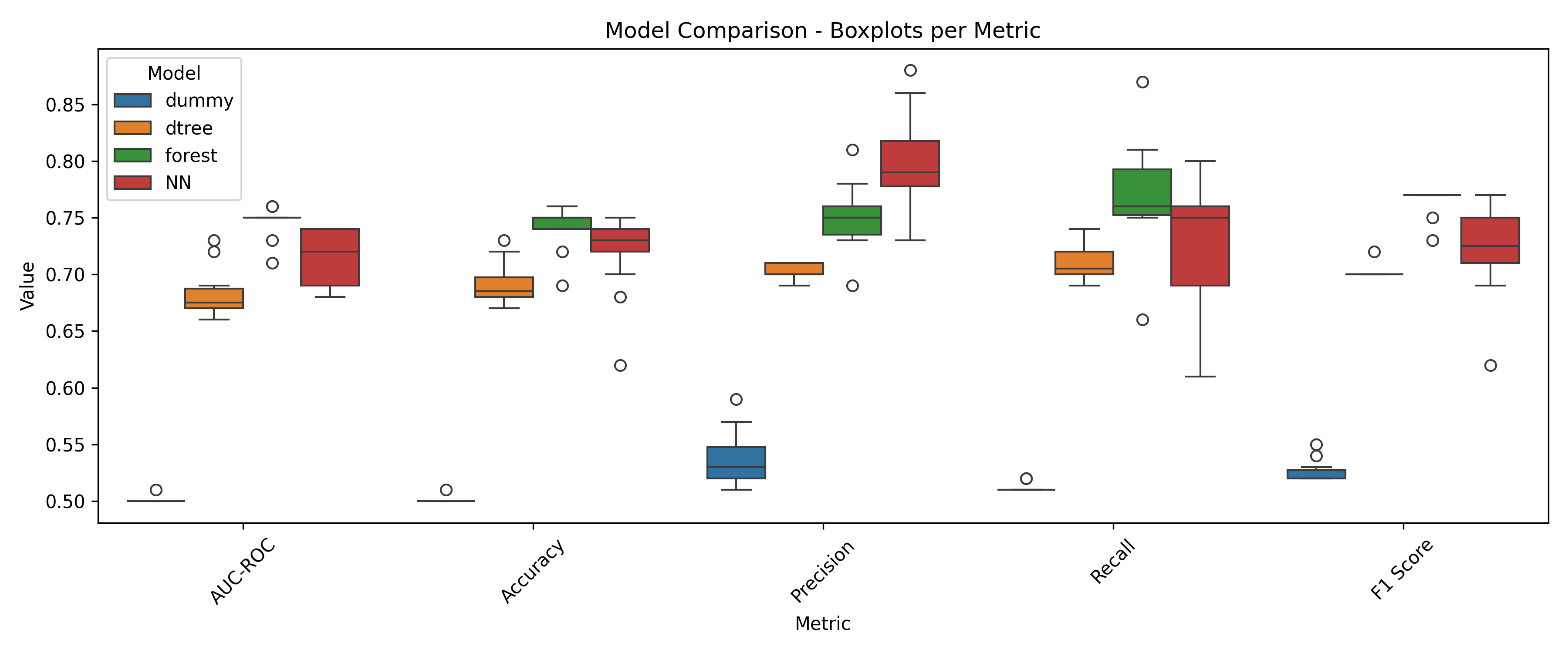
10-fold cross-validation boxplots
10-fold cross-validation results comparing classifier performance.

Related Work

Data

The underlying DOSE-I dataset is available for download via Zenodo. Accompanying this dataset, we have published a comprehensive technical documentation on arXiv.

The DOSE-I data includes five primary biosignals:

  • ECG is recorded at 500 Hz in mV with a ±500 mV range using a 3-lead configuration.
  • EEG is sampled at 125 Hz in microvolts with a ±187.5 µV range across two channels and multiple electrode pairs.
  • Plethysmography (PLETH), sampled at 125 Hz with a 0–100 range via a finger sensor.
  • Respiration (RESP), recorded at 62.5 Hz using impedance-based measurements.
  • Non-invasive Blood Pressure (NIBP), measured every 3 minutes across systolic, mean, and diastolic values using three channels.
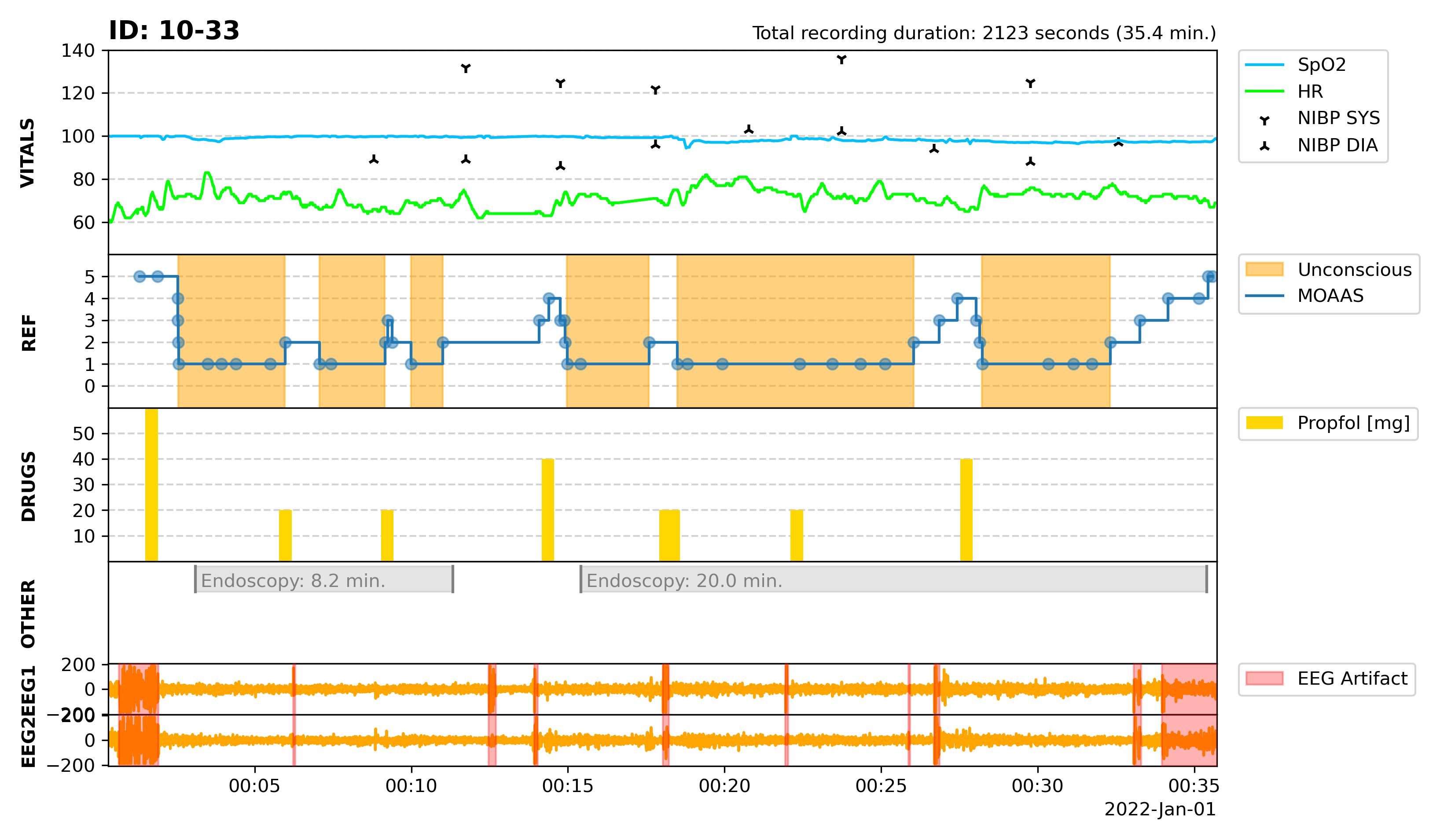
This data is further annotated with state-of-consciousness, MOAS/S, and clinical events. For a sample recording, see below.

EEG plot from recording 10-033
EEG recording from procedure 10-033 showing transitions in state of consciousness.

Code

Accompanying code for analysis of the DOSE-I dataset is available via our Github repository.

The repository includes tools for converting raw EEG data into a comprehensive set of processed EEG (pEEG) parameters, documentation of all extracted features, and machine-learning models for binary classification of conscious versus unconscious states.

BibTeX

When citing this study and our DOSE-I research in general, please use the following reference:
@incollection{garbe2026sedationEEG,
  author    = {Garbe, Jakob and Nguyen, Quang Vu and Kantelhardt, Jan W. and Dünninghaus, Florian
               and Erffmeier, Karla and Seeliger, Katja and Schmid, Thomas},
  title     = {Towards Predicting Sedation Depth in Endoscopy with Large Clinically Annotated
               EEG Data of Continuous Propofol Sedation},
  booktitle = {Artificial Intelligence in Medicine},
  series    = {Lecture Notes in Computer Science},
  volume    = {16749},
  publisher = {Springer},
  year      = {2026}
}

Acknowledgments

This work was supported by Deutsche Forschungsgemeinschaft (DFG, German Research Foundation) under Project number 547230187. We thank the neurologists Dr. Josephin Damm (Halle, Germany) and Dr. Leona Möller (Marburg, Germany) for annotation of EEGs and for their insights into signal quality, and bioinformatician Dr. Jan Grau for sharing and discussing his early prototype SoC classifier.